
At the end of my last post I admitted that my clothing situation was still unsettled. Shorts left my legs cold, and long pants had me overheating a few minutes into the session. Since late August the walk to the sports center before dawn has turned chilly, and every morning I stood in front of the closet for a few seconds, unsure. Cool-season workout clothes are not a grab-a-tee-and-go problem the way summer is. I spent a long time making and selling clothes, so this time I went looking for the answer in the fabric and in the order I put things on.
Shorts Were Cold, Long Pants Were Hot
The air in the sports center is cool when I arrive. In shorts, my calves stayed cold through the first two minutes of the warm-up, and as I wrote last time, my knees felt stiff in the first set. So I switched to long track pants, and got the opposite problem. Sweat started right around the end of the 10-minute warm-up, and by the second main set the inside of the pants was damp and heavy. After alternating for several days, it clicked: the issue was not length. It was fabric and the number of layers.
Workout Fabrics, Seen by Someone Who Used to Make Clothes
I flipped every tag in my workout drawer. Checking the fiber content first is an old occupational habit. I had two 100% cotton tees, and those are the worst thing you can wear before dawn in this season. Cotton absorbs sweat but will not release it, so the moment it gets wet it turns heavy and pulls heat away from your body. In summer that is merely unpleasant. When the temperature drops, it is cold.
A 100% polyester wicking knit does the opposite. The yarn is extruded with a special cross-section that pulls sweat to the surface and dries it fast. It is light and dries quickly, but offers almost no warmth. Polyester with 5 to 10% spandex works well for tights or a long-sleeve base layer. It hugs the body, traps a thin layer of air, and never gets in the way of a landing. The trade-off is that more spandex means slower drying. Thin brushed tricot is warm, but ten minutes into the warm-up it gets hot and the inside turns damp. That fabric goes back in the drawer until October.
The Answer Was Not One Outfit, It Was an Order
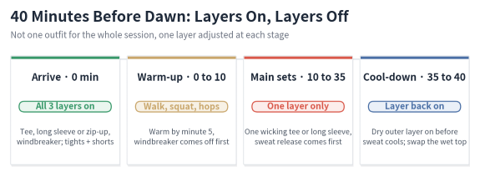
I stopped trying to survive 40 minutes in a single outfit and started adjusting one layer at each stage. On arrival I wear three layers: a wicking tee, a thin long sleeve or zip-up over it, and a windbreaker on top. On the bottom, thin tights with shorts layered over them. Around minute five of the warm-up, when I move from walking in place to squats and my body warms up, the windbreaker comes off first. Going into the main sets, only the wicking layer stays on. In that stretch, sweat release matters more than warmth. When I finish, a dry outer layer goes back on before the sweat cools, and the wet top gets swapped right away. Since making this change, both the cold first set and the damp second set have eased at the same time.
What I Wear, Sorted by How Cold It Feels on Arrival
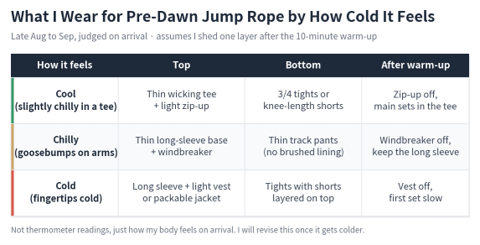
Rather than thermometer readings, I sorted it into three levels by how my body feels the moment I walk in. On a day that is only slightly cool in a tee, it is a wicking tee with one light zip-up, and 3/4 tights or knee-length shorts. On a day I get goosebumps on my arms, a thin long-sleeve base with a windbreaker, and thin long track pants with no brushed lining. On a day my fingertips are cold, a long sleeve plus a light vest or packable jacket, with shorts layered over tights. Each combination assumes I will shed one layer after the warm-up, so feeling slightly too warm on arrival is the right calibration.
Checkpoints Beyond the Tag: Look at the Seams
After fabric, I look at construction. Jump rope keeps your arms turning the whole time, so how the underarm and side seams sit against the skin matters. A standard overlock seam folds the allowance inward and leaves a raised ridge. A flatlock seam lays the allowance flat and stitches it down, and it chafes far less. Turn a tee inside out and run a finger along the side seam and you can tell instantly. On a long sleeve, thumbholes or a ribbed cuff help keep your fingertips warm during the warm-up. A windbreaker needs mesh vents under the arms or across the back, or you will not last the five minutes before it comes off. On the bottom, a waistband at least 4cm wide with the drawcord on the inside is what keeps things from sliding on every landing.
What Is Still Not Solved
Going to three layers created a new problem: more stuff to carry. A windbreaker and zip-up left in the corner of the GX room cool down while still damp, and they feel cold going back on. On days I move down to the basement squash court, there is no convenient place to change, which makes it more of a hassle. And the current setup is calibrated for early September. Once temperatures drop into the single digits, I will have to decide how much brushed fabric to bring in. The clothing question is not finished. I have found this season’s answer, that is all.
Wrapping Up
Cool-season pre-dawn workout clothes turned out not to be a shorts-versus-long-pants question. The key was to check the fiber blend first, drop the 100% cotton, treat one wicking layer as the base, and set an order for adding and removing a layer at each stage. Looking at construction details like flatlock seams and vents lowers the odds of a bad buy even further. If you train before dawn, I would suggest flipping the tags in your drawer this week. I have written several posts about buying clothes again on the way from 90.9kg to 75.3kg, but for workout gear, fabric came before size every time.