People sometimes ask me how to become a certified golf teaching pro in Korea. Once you actually look into it, though, the phrase covers two very different paths that are easy to mix up. One is a national license recognized by the Korean government, and the other is a certification run by a private association. The two differ in eligibility, what you need to prepare, and how the exam works. Here is what each organization’s official notice says you actually need to do.
Two Different Paths to Becoming a Golf Teaching Pro
The first thing to sort out is that ‘golf teaching pro’ is not a single certification in Korea. On the national side, there is the Level 2 Community Sports Instructor license (golf category), issued under Korea’s National Sports Promotion Act. On the private side, associations like USGTF (United States Golf Teachers Federation) issue their own golf teaching pro certification. The national license tends to matter more for coaching roles at schools, local government facilities, or public sports centers, while the private certification functions more like a practical credential for private lessons or working at a golf course or academy. Since the two serve different purposes, it is worth deciding which one you actually need before you start preparing.
| Level 2 Community Sports Instructor license (golf category) | https://sqms.kspo.or.kr/info/licenseInfoLsc2.kspo |
| USGTF | https://www.usgtf-korea.com/ |
The National License, Step by Step
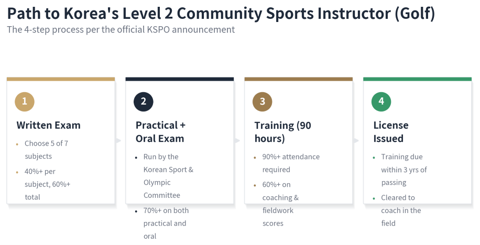
This license is managed by the Korea Sports Promotion Foundation (KSPO) and runs through three stages: a written exam, then a practical and oral exam, then training. You need to be 18 or older to apply. KSPO administers the written exam, while the Korean Sport and Olympic Committee handles the practical and oral exam. For the written exam, you choose 5 of 7 subjects, and you need at least 40% on each subject plus 60% overall to pass. The practical and oral exams each require a score of 70% or higher. The final stage is 90 hours of training, where you need at least 90% attendance and a score of 60% or higher on both coaching and fieldwork evaluations. One detail worth noting: you have to finish the training within 3 years of December 31st of the year you passed the written exam, or the license will not be issued.
The 7 Written Subjects, Pick 5
The written exam covers sport pedagogy, sport sociology, sport psychology, sport ethics, exercise physiology, biomechanics, and Korean sport history. You pick 5 of these 7. Candidates often say the difficulty feels different depending on which five you choose, but that comes down to your own background and how you study, so it is worth checking the latest past papers and criteria on KSPO’s site and picking the combination that fits you.

The Private Certification, USGTF’s Golf Teaching Pro
USGTF-KOREA’s process starts with the practical test. The Level 1 Playing Ability Test (PAT) is open to anyone 18 or older regardless of gender or experience, and it is a single round of 18-hole stroke play. The passing score varies by gender and age group, which I have laid out in the table below. Once you clear that, stage two is 4 days of training covering rules, theory, swing mechanics, and an oral interview. The entry fee is 300,000 won, with green fees, cart, and caddie fees extra, and a Level 1 pass is valid for one year. Testing happens across five regions in Korea, so it is worth checking the schedule for whichever region is closest to you before you register.

Which One Should You Prepare For First
The national license leads with a written exam, so it leans more on studying theory, and the practical bar is comparatively easier to clear. USGTF’s private certification, on the other hand, gates you on your playing score first, so it assumes you can already shoot a competitive round. If you want coaching experience that counts on an officially recognized track, the national license makes more sense. If your scoring is already there and you want to start teaching lessons soon, the private certification is the more direct route. Some people go for both, in which case the first thing to check is whether the schedules overlap.
Wrapping Up
Both the criteria and the schedule can change year to year. Everything here reflects each organization’s 2026 notice, so before you actually register, it is worth double checking the latest announcement on KSPO’s site, sqms.kspo.or.kr, or USGTF-KOREA’s official site. Whichever path you choose, deciding your goal first and then lining up the right written and practical requirements is the surest way to not waste your prep time.