
When I wrote about my plateau, I brushed past one line: “Why doesn’t the same workout take-off weight like it used to?” It kept nagging at me, so this time I sat down and actually worked out the jump rope calories. I started at 90.9kg and I am at 75.3kg now. I wanted to see, in numbers, how much less energy my body uses in the same 30 minutes at the sports center, and how that stacks up against the Han River runs I logged with my son.
Calorie Math Starts With a Number Called MET
MET is the standard used to estimate exercise calories. Sitting still counts as 1, and every activity gets a number for how many times more energy it uses than that. The formula is simple: calories per minute equals MET times 3.5 times your body weight in kilograms, divided by 200. The part that jumps out is body weight. Do the same workout for the same time, and the heavier you are, the more calories you burn. One reason weight comes off fast at the start of a diet and slows down later is sitting right there in the formula.
Jump Rope MET Runs From 8.8 to 12.3 Depending on Pace
The Compendium of Physical Activities lists jump rope MET values by pace. Under 100 turns a minute is 8.8, 100 to 120 is 11.8, and 120 to 160 is 12.3. That is 9 to 12 times the energy of sitting still. Walking is around 3 to 4 MET and light jogging is about 7, which explains why jump rope gets you winded so quickly. These days I turn from the wrist at roughly 110 turns a minute, so I used the moderate value of 11.8 for my own numbers.
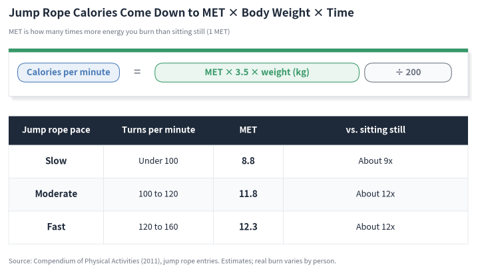
At 90.9kg vs. 75.3kg, the Same 30 Minutes Differs by Nearly 100 Calories
I plugged in my own weights. Assuming 30 minutes of nonstop jumping at a moderate pace, I burned about 563 kcal at 90.9kg and burn about 466 kcal now at 75.3kg. That is a 97 kcal gap. At a fast pace it is 587 versus 486, a 101 kcal gap. Roughly a third of a bowl of rice, every single day, quietly disappearing from the ledger. Seeing that in numbers took some pressure off, because my plateau was not just about slacking. Flip it around, though, and expecting the old results from the old workout was never going to add up.

With Intervals, I Am Not Actually Jumping for 30 Minutes
Here is where I have to be honest. Those figures assume the rope is turning for the full 30 minutes, and I cannot do that. I jump in sets of 300, catch my breath, then go again. So even if I spend 30 minutes at the sports center, the rope is actually turning for a little over half of it, call it 16 minutes if I am generous. Count only those minutes and the number drops to 249 kcal. That is a lot less flattering than what my watch or an app would show. My heart rate stays up during the rest periods, so some calories are still going, but I learned not to count rest time as jumping time.
Compared to a Measured 409 kcal Han River Run
On July 31 my watch logged the run I did with my son along the Han River: 5.99km in 1 hour and 49 seconds, 409 kcal, average heart rate 118. That works out to about 6.7 kcal per minute. Moderate jump rope is 15.5 kcal per minute, so on efficiency alone jump rope wins by more than double. Look at the whole session and the story flips. The run was 61 unbroken minutes, while my interval jump rope session had 16 real minutes of jumping. That day’s 409 kcal run beat my usual 249 kcal jump rope session. Jump rope really is efficient, but only while the rope is turning.

What I Changed, and What Is Still Unresolved
After running the numbers, I changed two things. First, I started timing my rest between sets. I used to rest until my breathing settled, however long that took. Now it is a fixed 45 seconds, and the actual jumping time inside 30 minutes went up noticeably. Second, I log minutes of rope time instead of rep counts. Some things are still open. Pushing the pace toward 12 MET burns more, but my knee is the first thing to complain. And both the MET math and the watch number are estimates, so neither is exactly what my body used. In the end the scale and the InBody printout are the only readings that settle it.
Wrapping Up
Thirty minutes of jump rope does not burn a fixed number of calories. It moves with your body weight. The 30 minutes that burned 563 kcal at 90.9kg burns 466 kcal at 75.3kg, and that was part of why my plateau showed up. Subtract the interval rest time honestly and my real burn was about half of what an app would claim. I have accepted that the same workout will not keep producing the same result as the weight comes off, and I am slowly extending my actual jumping time instead. In the next post I will share what a month of the 45 second rest rule did to my real jumping minutes and my weight.