
A little while ago I started tracking my runs with a smartwatch, and one number I’d never paid attention to before suddenly stood out: heart rate. I did over 100 days of jump rope without ever checking it, but once my son and I started running along the Han River and numbers like 118 and 124 kept popping up on the screen, I wanted to know what they actually meant. Was I pushing too hard, or barely working at all. So I looked into target heart rate for people in their 40s and worked out how to calculate it myself.
Why I Never Bothered With Heart Rate Before
While I was losing weight from 90.9kg to 75.3kg with jump rope, I only judged my effort by how out of breath or sweaty I got. That changed once my son and I started running the Han River together and the Nike Run Club app started logging an average heart rate every time. 124 on the first day, 118 the next. Going by the numbers alone, day two looked easier, but I had no idea what that actually meant. I’d been training by feel for months, and only now was I starting to look at the data.
How to Calculate Your Max and Target Heart Rate
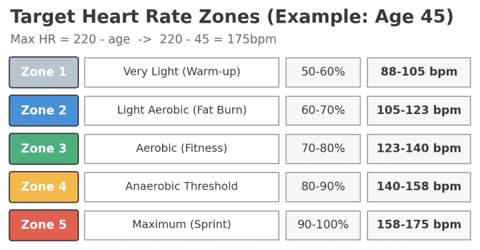
The most common method is simple: 220 minus your age. Using 45 as an example for someone in their mid-40s, that’s 220 minus 45, which puts max heart rate at 175bpm. From there, you multiply by a percentage that matches your goal. Easy walking sits around 50 to 60 percent of max heart rate, while aerobic exercise for weight loss or fitness usually falls in the 60 to 80 percent range. Just knowing this one formula meant I could finally put a number on how hard a given workout actually was.
What Each Zone Actually Feels Like
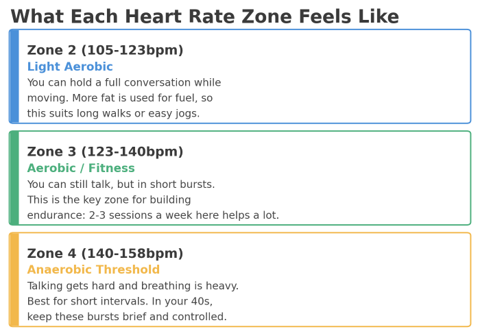
Breaking it into five zones makes it easier to picture. Zone 1 is a light warm-up. Zone 2 is easy aerobic work where you can chat the whole time. Zone 3 is aerobic training where you can still talk, but only in short sentences. Zone 4 is high intensity, where holding a conversation gets difficult. For a 45-year-old, Zone 2 works out to roughly 105 to 123bpm, and Zone 3 to about 123 to 140bpm. Having it laid out this way made it easy to tell, at a glance, whether a given run was easy aerobic work or something closer to a fitness-building effort.
Where My Real Han River Runs Actually Landed
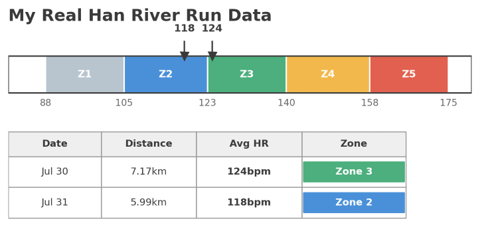
On our first run on July 30th, I covered 7.17km with an average heart rate of 124bpm, which for a 45-year-old sits right at the start of Zone 3, the aerobic fitness zone. The next day, July 31st, I ran 5.99km with an average heart rate of 118bpm, landing at the tail end of Zone 2. Both distance and pace dropped that second day, and so did my heart rate, which confirmed something I’d only sensed before: my body was pacing itself down on its own. Seeing it as actual numbers made it click in a way that just feeling tired never quite did.
Using Heart Rate to Manage Intensity
Once I understood the numbers, it changed how I approached each run. On good days I push into the upper end of Zone 3, and on tired days I try to stay inside Zone 2. That said, I’m careful not to treat the number as gospel. Smartwatch heart rate readings can be off, and the same pace can produce a different reading depending on weather or how rested I am. I treat the number as a reference point, not the whole story. How well I can still talk, or how my breathing feels, still matters just as much.
Wrapping Up
One simple formula, 220 minus your age, turned my workout intensity into something I could actually measure. 118bpm and 124bpm looked like unremarkable numbers at first, but they turned out to be real evidence that my body responds differently day to day. Checking your heart rate doesn’t take expensive gear or special knowledge. A smartwatch and one subtraction problem is really all it takes.