
It has been over a month since I moved down to the squash court in my sports center’s basement. In my last post I wrote that the cushioned squash court floor felt noticeably easier on my knees than the GX Room’s bare wood floor. But my jump rope knee pain never fully went away. Changing the floor wasn’t the whole answer. Here is what I tried next.
The Pain That Stuck Around Even After the Floor Change
Landing impact dropped noticeably after I switched floors. But the morning after a jump rope session, my knee still felt stiff walking down stairs. It was worse on days I did a lot of double unders or other high intensity moves. The floor solved half the problem. I had to find the other half somewhere else.
What I Tried First: A Knee Sleeve
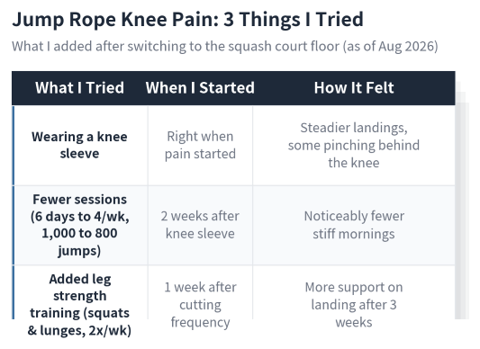
The first thing I bought was a knee sleeve, a compression band that wraps around the knee. It presses gently around the kneecap and keeps the knee from wobbling side to side while jumping. The first time I wore it, landings felt noticeably more stable. But it felt tight enough that jumping for more than 30 minutes left a pinching feeling behind my knee. I stopped thinking of it as something that erases pain and started treating it as a support tool that holds the knee steady.

Second: Adjusting How Often and How Much I Jump
The knee sleeve alone wasn’t enough, so I adjusted my schedule too. I used to jump six days a week, often over 1,000 jumps a day. Once the pain started, I cut that to four days a week and brought the daily count down to around 800. On rest days I skipped jump rope entirely and just walked. The scale didn’t move much that first week, but mornings with a stiff knee dropped noticeably.
Third: Adding Lower Body Strength Training
I read that a lot of knee pain doesn’t come from the knee itself. It comes from weak muscles that are supposed to support it, mainly the quads (front thigh muscles) and glutes. So I started doing squats and lunges on my rest days. I began with 3 sets of 10 bodyweight squats and 8 lunges per side, and I am now up to 3 sets of 15 squats. It has been about 3 weeks since I added strength training, and landings feel more supported than before.

What Still Hasn’t Gone Away
Even with the knee sleeve, fewer sessions, and strength training combined, the pain hasn’t disappeared completely. On days when I’m not feeling well, especially after a bad night’s sleep, my knee still feels stiff on the inside. I’m slowly accepting that joints don’t work the way they used to as you get older, and that accepting that is part of managing it too. Resting without guilt on the bad days has been the biggest lesson so far.
Wrapping Up
Changing the floor alone wasn’t enough. It took a knee sleeve to hold the joint steady, fewer sessions to cut down the load, and strength training to build up the muscles around the knee before the pain became manageable. It still gets stiff sometimes, but now I know that’s a signal, not a failure. Knowing when to rest is just as much a part of sticking with jump rope long term as the jumping itself.